


Card Author:
Location:
Date:
The first certain news of the church of San Pietro dates back to April 14, 1202, deduced from a deed of donation by the presbyter, prior and rector of the church of San Pietro, who donated the aforementioned church to Stefano Abbot of the monastery of S. Silvestro in You understand in Rome.
Info: Info point Vitorchiano – Pro loco Vitorchiano. Piazza Roma, s.n.c. Tel. 0761373739prolocovitorchiano@gmail.com – infopointvitorchiano@gmail.com
Facebook page Pro loco Vitorchiano
Municipality of Vitorchiano, Tourist Office – Piazza Sant’Agnese, 16 – cap. 01030 – tel. 0761373745. www.comune.vitorchiano.vt.it, e-mail info@comune.vitorchiano.vt.it




CHURCH OF SAN PIETRO
THE HISTORY
The scarce documentation referring to the Church of San Pietro does not allow us to better reconstruct the historical events that marked the fate of the building. Its first attestation dates back to April 14, 1202 and consists in the confirmation of the donation of the aforementioned that the priest prior and rector of the church Pietro, made to Stefano, abbot of the monastery of S. Silvestro in Capite in Rome. The confirmation took place in a solemn form, present the Bishop of Bagnoregio, head of the diocese to which Vitorchiano belongs, the Roman senator Guntablacca, rector of the castle and legate of Tuscia, various presbyters and deacons and the community of the castle. In particular, the donation of several churches was confirmed, located both inside and outside the “castrum”: ecclesiam S. Petri et Nicolai iusta portam muri et acclesiam S. Salvatoris cum hospitali iusta portam Canalis et ecclesiam S. Marie, positam extra dictum castrum in loco qui vocatur Braççanum. We therefore mention the Church of S. Pietro, also known as S. Pietro and S. Nicola, the Church of S. Salvatore with the hospital and the Church of Santa Maria, located outside the castle. In the past, the road that leads to S. Pietro was one of the two main axes of the road system outside the “castrum”. At the end of the twelfth century, the church was in full swing and possessed an abundant amount of movable and immovable property. The churches named in the 1202 document, S. Salvatore and Santa Maria, probably must have belonged to S. Pietro. Since the church in question covered an apparently independent position with respect to the “castrum”, external to the main enclosure, it can be assumed that it performed the function of parish, the main church of its territorial district. It will later be Santa Maria who will progressively fulfill this function (so much so that even today the title of parish is retained), to the detriment of St. Peter, who fell into complete abandonment. From a document dated February 15, 1658 we learn the passage in emphyteusis of all the assets belonging to the aforementioned churches to that of S. Nicola, confirming, however, at the same time, the ownership of them in S. Silvestro in capita. This solution was intended to partially release the two churches from the Roman monastery, bringing them closer to the local reality, until in 1775 the complete transfer of the two churches and all the assets connected to them took place, to the brothers Don Antino and Antonio Onesti of Vitorchiano , for the share of 200 scudi. Deconsecrated starting from the middle of the last century, and in a state of neglect until 2012, the church has undergone a restoration. The Municipality of Vitorchiano has recently provided for the conservative restoration of the monument with the supervision of the superintendency. The static conditions of the entire building were made safe and a trussed roof was created.
DESCRIPTION
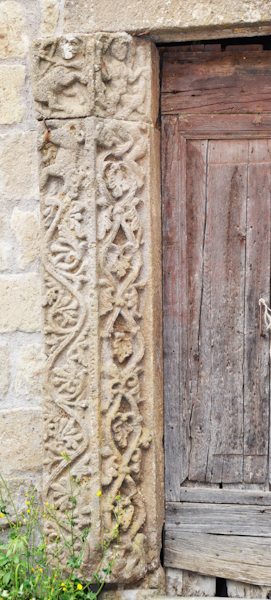
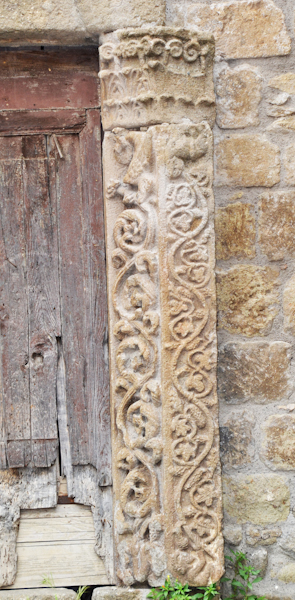
The church of San Pietro is located outside the second walls, confirming its character of a parish church. It has a gabled façade with exposed stones, with a simple rose window in the center slightly placed in depth with respect to the façade. At the level of the floor, raised on four steps, is the access door, not aligned with the rose window and flanked by jambs decorated in bas-relief. Above the architrave there is a lunette surmounted by a white marble plaque. A little higher, on the right, you can see a face carved in peperino and placed on the façade, of which you can barely recognize some features. Going up the four steps, almost completely infested with grass, you find yourself in front of the entrance portal to the church, almost completely destroyed. At the corners, with the function of jambs, two pillars were placed with capitals completely worked in bas-relief with volutes and fancy elements, with different decorations on each side of the single pillar and both different from each other. Above, a smooth architrave separates the portal from a lunette, made of stone and stuccoed inside, perhaps painted in ancient times. On the lunette a white marble plaque in which there are images and an inscription in Latin. Slightly engraved is the figure of a man dressed in papal clothes, with a tiara, a large cope and a richly draped tunic, holding the papal insignia, crushing a dragon: the iconography of the Pope’s San Silvestro. Also in the inscription below, more evident than the figure of the pope, we find the reference to San Silvestro together with that of San Pietro to whom the church is dedicated. The inscription mentions: HABO EST ECCLESIA S. PETRI SPECTAN AD VEN MONASTERI ET MONIALES S SILVESTRI DECAPITE URBIS. The right monolithic pillar with a triangular base that acts as a jamb of the portal has surfaces differently decorated and made in bas-relief: on the external face are sculpted vine shoots and, in the groove, large leafy spirals supported below by a rough human figure and bitten at the top from an animal; in the other phytomorphic spirals run the entire length of the inner face. The jamb is dominated by a capital with acanthus leaves just in relief and swirls at the top. This portal thus constituted is the translation of Romanesque motifs reinterpreted with rough art by some local craftsmen. However, it is interesting because it is the only example of this kind in the surroundings of Viterbo. The monolithic left pillar, also with a triangular base and which acts as a jamb of the portal, presents on the external façade a branch with palmetto leaves interspersed and in the corner two branches ending at the top and at the bottom with two rough human figures, also present at the ends of the phytomorphic spirals of the second surface. The capital is also divided into two parts: in one there is a sagittarius, while in the other a human figure is represented, holding two torches, probably the rise of Alexander the Great carried by griffins. Inside, the church has a single single nave nave, which is accessed via a wooden walkway. From the walkway you can see the back wall with the apse, both frescoed, and the trussed roof.
On the right is a window, the only source of light together with another window located at the level of the walkway and the oculus. Below the walkway are ancient burials, part of the town cemetery in the past annexed to the church, discovered under the walkway to the right and left of the walkway following the excavations made between 2009-2010. Two large steps lead to the presbytery with the apse, in front of which is a peperino altar. On the sides there are two stone benches, while further on, on the right wall, a niche with a round arch is visible. The back wall of the church, completely frescoed, although in a bad state of conservation, is not uniform, but the central part, in which the apse is then placed, is recessed with respect to the two side parts which also have a smaller surface. The decoration extends over two levels and can be ascribed between the end of the 15th and the beginning of the 16th century. The scenes are inserted in fake classical style architecture. In the center of the recessed wall, in the upper register, Christ was depicted enthroned with Saints Peter and Paul, of which almost completely no trace has been lost; in the apse is the Crucifixion of Christ. The scene is framed by a fake architectural frame with the under-arch decorated with classical scrolling elements on a yellow and red background. The arch of the niche is in trompe-l’oeil painted marble, now damaged by atmospheric agents. The thickness of the emerging walls is instead decorated with false classical pillars. The cross is placed in the center of the niche with a drapery painted on the back which has the function of highlighting the figure of Christ. On the left, St. Francis with a wide habit stretches his arm towards the cross and seems to be one with the cliff that is behind him. On the right is a saint with a long white beard, identifiable on the basis of the photo, dating back to 1977, relating to the description of the painting, as St. Jerome, identified, however, as St. Mark the Evangelist by the compilers of the same card, with a long purple tunic with ocher yellow lapels; in the background behind him you can see in depth some buildings, the same of the Nativity of St. Nicholas in the church of the same name. At the level of the floor there is the altar made with three simple blocks of peperino. The Crucifixion scene is very ruined. There are drops of color in many points of the scene, including the faces and the body of the figures of St. Francis and Christ on the cross; As for the figure of St. Jerome, the plaster has almost completely fallen off, making only the face and left arm of the saint visible with the background behind him. The two portions of the side wall of the apse are also divided into two registers according to a specular layout. The left portion presents in the upper register a figure of which only the lower part of the robe and one foot remain visible; in the lower register a plate and a monochrome festoon are visible. It is impossible to say how the decoration was completed at this point, since the plaster fell off to a height of approximately. 2 m. This fall revealed a piece of the previous layer attached directly to the masonry. The cross decoration present on this first layer can be dated between the end of the 13th and the beginning of the 14th century and determines an ante quem term for the construction of the masonry. The right portion presents in the upper register, in a false niche, an almost completely visible saint dressed in a tunic with a red cloak tied on his chest with an open book in his hands. The dress with a very regular drapery gives composure to the figure which, however, through the position of the legs, hints at a movement, as if he were walking. The drapery can be found similar in the procession scene of St. Nicholas while the physical position of the figure is typical of the Jesus of Baptism in the Jordan. While feeling very much the Zellian influence, this is limited to minor details. In the lower register, in a classical frame made in trompe l’oeil, is a saint commonly identified as St. Bartholomew who is also almost completely visible. The saint is depicted with a tunic that covers only his left shoulder. His skin color is very dark, probably due to the changes that the paint has undergone over time under the action of atmospheric agents. In the landscape, after a first building visible on the right, small clusters of buildings rise in the background. While nothing changes in the physiognomic characteristics of the character, in all similar to the figures of the church of S. Nicola, the painter’s landscape is affected here by a strange influence, which cannot be ruled out as belonging to Truffetta. The frescoes attest to a very active Viterbo subschool. The counter-façade is devoid of decorations, but the oculus is visible in the upper part. On the right wall there is one of the two windows inside the building.
ESSENTIAL BIBLIOGRAPHY
Vitorchiano, il passato presente, edition edited by Fiorenzo Mascagna, historical research by Elide Vagnozzi, Stampa Arti Grafiche Artigiane 2005.
Picchetto F.- Pedrocchi A. M, scheda OA n.12/00095308, 1977.
Picchetto F.- Pedrocchi A. M, scheda OA n.12/00095309, 1977.
Picchetto F.- Pedrocchi A. M, scheda OA n.12/00095312, 1977.
Picchetto F.- Pedrocchi A. M, scheda OA n. 12/00095315, 1977.
Picchetto F.- Pedrocchi A. M, scheda OA n. 12/00095316, 1977.
Picchetto F.- Pedrocchi A. M , scheda OA n. 12/00095317, 1977.
Toscano M., Vitorchiano nel Medioevo: la chiesa di S. Pietro, Sutri (Vt) 2005.
– Facebook page of Andrea Presutti Special thanks to Dr. Andrea Presutti for scientific advice and archival photographic material provided on Vitorchiano.