



Card Author:
Location:
Date:

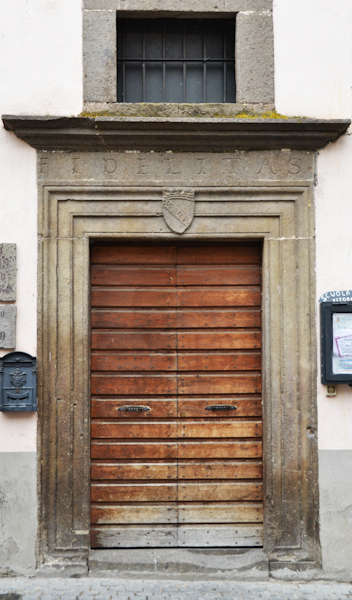
The Fidelitas palace, located within the second circle of walls in Piazza Roma, most likely arose to coincide with the second phase of city development, at the turn of the fourteenth and fifteenth centuries. construction began immediately outside the most ancient gate of the village of the Madonna della Neve.
Info: Info point Vitorchiano – Pro loco Vitorchiano. Piazza Roma, s.n.c. Tel. 0761373739prolocovitorchiano@gmail.com – infopointvitorchiano@gmail.com
Municipality of Vitorchiano, Tourist Office – Piazza Sant’Agnese, 16 – cap. 01030 – tel. 0761373745. www.comune.vitorchiano.vt.it, e-mail info@comune.vitorchiano.vt.it



FIDELITAS PALACE
HISTORY AND DESCRIPTION
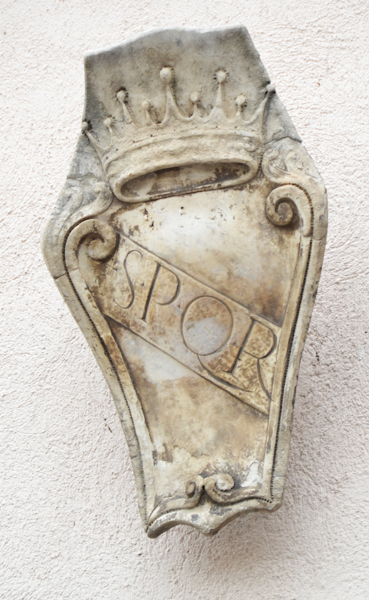
The Fidelitas palace was most likely built to coincide with the second phase of city development, when at the turn of the fourteenth and fifteenth centuries, construction began immediately outside the oldest village gate (door of Santa Maria della neve). The dating of the nearby church of Sant’Antonio (1465) and its typically Renaissance appearance, albeit without documentary support, could suggest a coeval dating to the 15th century. Located within the second circle of walls in Piazza Roma, the building rises on three levels that have decreasing height, separated by string courses that also run along the façade to the right. On the left, the building communicates with a house. The entrance door is surmounted by a smaller window and flanked by two grated windows, one on each side. The entrance door is surrounded by a fluted architrave and jambs with the emblem of the city of Rome in peperino stone in the center and, at the top, on the architrave, the word FIDELITAS engraved in large block letters. On the left side there is still a small door with access below the floor, an access arch to a small street and finally a small window. The building is also called Palazzetto della Cultura because it is home to the Pro Loco, the ASD -TEAM ALBATROSS (sport fishing company) and the town’s music school, as indicated by the inscriptions engraved on the facade. The second level has four windows and has applied the coat of arms of Rome between the second and third and, to the right corner of the building, that of Vitorchiano on which the surrounding walls and the Roman Gate are recognizable, surmounted by the acronym SPQR. of the city of Vitorchiano, the walls are inscribed in an oval surrounded by scroll decorations in relief with the Latin phrase VITOR-MEBV-ROMANU engraved on the sides and at the bottom. Around other decorations in relief and engraving. The last order has four smaller windows than the others due to the low height of the walls. The other visible facade is characterized by two access doors on the lower level, three windows on the first level, two of which are walled up, while on the third level there are as many windows, one of which is walled.
ESSENTIAL BIBLIOGRAPHY
Special thanks to Dr. Andrea Presutti for scientific advice and archival photographic material provided on Vitorchiano.
– Vitorchiano com’era Facebook page for collecting old photos of the beautiful village of Vitorchiano, in the province of Viterbo. Images of the country, its inhabitants and its traditions.


