



Card Author:
Location:
Date:
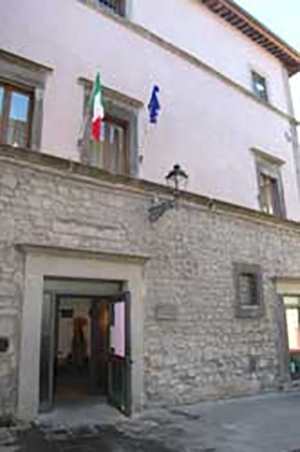
The chronicles of Vitorchiano by the chronicler of the sixteenth century. Curzio Gobbino, indicating the Town Hall built next to the ancient fortress at the turn of the fifteenth century and the beginning of the next, with the work entrusted to “Magister Bernardum”, a Lombard master who has been active in the area for some time.
Info: Info point Vitorchiano – Pro loco Vitorchiano. Piazza Roma, s.n.c. Tel. 0761373739prolocovitorchiano@gmail.com – infopointvitorchiano@gmail.com

Municipality of Vitorchiano, Tourist Office – Piazza Sant’Agnese, 16 – cap. 01030 – tel. 0761373745. www.comune.vitorchiano.vt.it, e-mail info@comune.vitorchiano.vt.it


MUNICIPAL BUILDING (Palazzo Comunale)
HISTORY
The chronicles of Vitorchiano by the chronicler of the sixteenth century. Curzio Gobbino, indicating the Town Hall built next to the ancient fortress, according to the agreements stipulated between the city authorities of Vitorchiano and the Roman institutions in the fifteenth century. The works, entrusted to “Magister Bernardum”, a Lombard master who had been active in the area for some time, ended at the beginning of the sixteenth century. Its construction therefore dates back to the turn of the fifteenth century and the beginning of the next, although probably in the previous centuries a building already existed in what is identifiable according to sources in the ancient fortress. Leaning against the side of the building, which overlooks Piazza Roma and the walls of the village, we find the clock tower, an integral part of the building. At the base of the clock tower there is an epigraph dated 1320. Inside there is a municipal ban carved in Gothic characters, which prohibits homicides and traitors from staying in the castle of Vitorchiano under penalty of a large fine. The epigraph could be a direct indication of the existence of the building as early as the early fourteenth century. Unfortunately, it is not known whether the construction of the tower had already taken place on that date or the epigraph and only waste material, then inserted into the wall at the base of the tower later. Undoubtedly, its content is purely civic and social for its purpose and value. Almost as a function of customary rule that could form part of the municipal legal system, clear evidence of the common sense of protection and an administrative reality already well defined in the fourteenth century. In any case, its location in Piazza Roma expresses its purely medieval value as a “place of power”. In the Middle Ages all the great public events were held in the town square: assemblies, executions, shows, markets and processions. The square is testimony to this organization of power. Just as the Town Hall was the symbol of municipal power, the public square it overlooked was translated as an expression of municipal autonomy, the perfect place for communication through a notice placed in a public square. Another walled element near the same tombstone could help us in a chronological framework of the building. It is a fragment of a carved shelf, on which an engraved date “1549” appears. Incorporated into the masonry of the building it could result as an ante Quiem term of reference. The construction or rebuilding of the structure may have seen an intervention after the date engraved on the stone. This could be a sine qua non as long as it is a waste material, in fact reused from pre-existing buildings. However, for a certain date of construction of the town hall, the only chronological reference is the term ante quem available in the document where the works appear, entrusted to “Magister Bernardum”, between the end of the 15th century and the beginning of following. Recently the tower and the town hall have been the subject of a restoration project carried out thanks to the contributions of the Lazio Region, as part of an extraordinary three-year program of public works for local regional development. The restoration, included within the rehabilitation works of the municipal building, carried out by the municipal administration, lasted less than two years, and returned to the building and the clock tower their value, with renovations and of redevelopment completed in May 2008. The restoration of the Council Room was precisely the last intervention that saw the completion of the architectural restructuring of the Palazzo.
DESCRIPTION
THE OUTSIDE. For a visit to the Palazzo Comunale di Vitorchiano once you enter the village through Porta Romana and along Via Arringa, you reach Piazza Roma. In front of the square, the south side of the Town Hall is beautifully displayed, immediately behind the spindle fountain. To access the palace, you will have to go through the second door of the village, the door of the snow, located on the left of the fountain, and immediately afterwards on the right we will find ourselves in Piazza Sant’Agnese, where the main entrance of the Town Hall is. The north side, where the main entrance to the building is, is characterized by three levels marked on the facade by a decreasing height, interspersed with string courses. The lower level, on which the large entrance is, is completely covered with peperino ashlars. The upper levels, on the other hand, are simply stuccoed and on them there are Guelph cross windows with grooved jambs. The south side of the building, which overlooks Piazza Roma, has the same subdivision, with the difference that both the first and second levels are completely covered with peperino ashlars. Here on the facade there are two windows for each level, which are embedded in the first level. In the second level, the windows are characterized by a Guelph cross structure and on the architrave there is also an inscription “SUMMA FIDELITAS”. In the last level the windows are smaller in size for the last one. The west side of the building that overlooks the door of the Madonna della Neve, has a staircase (profferlo) that leads to a secondary entrance of the Palazzo Comunale now no longer in use, beyond which is the entrance to the clock tower and a balcony. This facade of the building is also marked by string courses that identify two levels on which some windows open.
THE INTERIOR
Back at the main entrance, once inside, we will find a large, completely renovated atrium, with an architrave with a grooved upper frame and a cross vault with peperino elements at the base of the pendentives. On the back wall is the entrance to the offices, next to which on the left is an epigraph in peperino with a Latin inscription engraved “DEO ROMAEQUE – ESTO FIDELIS”, placed in 1969, which celebrates the seventh centenary of the establishment of the faithful of Vitorchiano against the city of Rome. In the epigraph, top left, is the coat of arms of the city of Vitorchiano inscribed in a clypeus. On the right of the entrance hall, introduced by two round arches with peperino columns and large composite capitals also in peperino, we find a side room. On the capitals rest the cross vaults of both rooms. In the classroom there are glass tables in the center, while on the walls there are two murals and a marble epigraph. The epigraph on the back wall has a profile face in high relief at the top, inscribed in a clypeus, under which is an engraved dedication, in Latin: PETRO ONESTIO / QUOD VETUSTISSIMUM PRIVILEGIUM / OB EXIMIAM IN S.P.Q.R. FIDELITATEM / VITURCLANENSIBUS ATTRIBUTUM / YEAR MDCCCXLVII POENE ABOLITUM / SINGULARS ERGA PATRIAM CARITATE / RESTITUENDUM ACREDINTEGRANDUM CURAVIT / EOQUE E VIVIS AEREPTO / CURA ET INSTANTIA CAMILLI ECCUMIUS FCEU INSIGNA EIUS IN SINGULOS UNIVERSOSQUE MERITA / HOC PUBLICUM GRATI ANIMI TESTIMONIUM / CIVES CONCIVI SUO DECREVERUNT / MUNICIPII MAGISTRATUM OCCUPANTIBUS / ANTONIO ONESTIO P / V. ORLANDIO S. OLIVERIO I FORTUNATO L. FABRIO S / C. FATTORIO A.S. On the left wall there is, located in a rectangular niche of the hall, the photographic reproduction of the mural painting placed in the church of the Madonna di San Nicola, on the right wall, depicting St. Michael the Archangel killing the dragon, inserted under a trumpet arch. ‘oeil, decorated with classic motifs. The gigantic figure of San Michele dominates the walls of the city of Vitorchiano in defense of him. Inside the entrance hall on the left of the entrance, there are two mannequins dressed in the historical clothes of the inhabitants of Vitorchiano. Once you enter the atrium, on the left, there is a small corridor beyond which there is an elevator that leads directly to the second floor, otherwise a modern wooden and iron staircase leads directly to the upper floors. Going up to the first floor, you will find an incomplete helmet armor at the corner, beyond which is the access to other rooms. after a passageway you arrive at the Council Chamber. The large hall with a wooden trussed roof hosts on the upper walls a decorative band frescoed by Viterbo artists in the 15th century. Here in the large hall the Municipal Council meets and on whose walls there are: a small semicircular pulpit with a frame and three embossed coats of arms (one of Rome and two of the Municipality), and a fireplace both in peperino. Along the walls there are some doors that have the architrave engraved with phrases related to the relationship of loyalty with Rome. “Romano imperio perpetuo dicatum”; “Perpetually devoted to the Roman Empire”; “Romano imperio summa fidelitas”; “Supreme loyalty to the Roman Empire”; “Deo Romaeque esto fidelis”; “Be faithful to God and to Rome”. The cycle of frescoes ascribable between the end of the fifteenth and the beginning of the sixteenth century takes on particular importance, due to the high artistic value. present in the counseling room, object of interest and study by art historians. The cycle was created by artists from a local school in northern Lazio on the band of the hall with putti holding the coat of arms, including that of Rome and Vitorchiano, which rest on an architectural band made in trompe l’oeil. The representation of the cycle was conceived in conjunction with the palace. The recovery of the fresco was started in November 2007 to be completed in May 2008. The project, entrusted to the architect Delia Pozzi, under the direction of the Superintendence for Artistic Heritage of Lazio in the figure of Gianni Tiziani, saw the ‘execution of the works entrusted to prof. Giorgio Capriotti, as head of the restoration and to his assistants. The professor. Capriotti, technical director of the restoration laboratory of the Province of Viterbo and professor at the University of Tuscia, reported at the end of the works the conditions of illegibility, in which the fresco was received, aggravated by previous restoration interventions defined to say the least “clumsy “. The representation develops along the entire perimeter of the Council Room close to the ceiling. The cycle, of canonical origin, recalls heraldic elements, interposed by the “puttini” (naked children with wings) and the iconographic connotations evoke the architectural context in which the she-wolf was conceived, with a repetition of data such as yellow and red. , the Capitoline coat of arms, the castle, etc. The painting of the “Madonnina” takes on particular importance to symbolize a function of public justice, given the place where the oaths were taken. It is assumed that it was made at different times. While the cycle continues with dry painted garlands (more fragile technique), adopted to give a chromatic revaluation to the painting. The historical events, experienced by the cycle, have gone through a post-unitary phase testified by the presence of the Savoy coat of arms. In this passage, it is possible to notice some interventions of concealment and overall scratching, until then intact, for which the reconstruction was operated between the existing parts and those abraded. The high altitudes have suffered irreparable damage. The restoration has ensured the safety of the original parts, in search of an objective rebalancing between history and aesthetics according to the principles of modern restoration. From a material point of view, the pictorial cycle was consolidated with the injection of fluid mortars and the re-adhesion of the detached fragments, followed by the removal and actual cleaning, which took place by compressing with basic solutions and specific solvents. Complete the intervention, the realization of mortars in undertone and squaring. On the walls of the hall, some large canvases are preserved, coming from the former Monastery of Sant’Agnese, now used as an Auditorium. On the right wall, there are several canvases: the first is the 17th century canvas, attributed to Calisti Calisto on a stylistic basis, depicting Saint Lucia crowned by two angels. The work constituted the lateral altarpiece of an altar pediment inside the Municipal Auditorium, formerly the Monastery of Sant’Agnese, together with the canvas with Sant’Orsola. In the center was instead the altarpiece with the Madonna enthroned with the Child seated on the clouds together with San Domenico and Santa Caterina da Siena. The Saint, who wears soft drapery robes, is in the act of moving, and holds her plate with her eyes in his right hand and her martyrdom palm in the other, according to traditional iconography. This is followed by the 17th century canvas, from the Viterbo area, depicting St. Ursula crowned by two angels, one of whom holds the white banner with a red cross, as a sign of victory over death by means of martyrdom. The work constituted the lateral altarpiece of an altar pediment inside the Municipal Auditorium, formerly the Monastery of Sant’Agnese, together with the canvas with Saint Lucia. In the center was instead the altarpiece with the Madonna enthroned with the Child seated on the clouds together with San Domenico and Santa Caterina da Siena. Her Saint holds her arrow in her right hand, a symbol of her martyrdom, while in her left she holds her palm. Behind her the boat with which she made her journey, another iconographic symbol. Immediately after is the Roman canvas, from the beginning of the seventeenth century, with derivations from Pomarancio and A. Grammatica. The canvas depicts St. Bonaventure with the tiara, the crosier and the open book in his hands, between St. Augustine and St. Agnes, depicted together with a sheep, holding the palm of martyrdom in his hands. Above are depicted winged cherubs in the clouds. The work constituted the central altarpiece of an altar inside the Municipal Auditorium, formerly the Monastery of Sant’Agnese, together with the paintings with Santa Caterina and Santa Apollonia. This is followed by the 17th century canvas, from the Viterbo area, depicting Santa Apollonia d’Alessandria, as indicated by the inscription below. The work constituted the lateral altarpiece of an altar pediment inside the municipal Auditorium, formerly the Monastery of Sant’Agnese, together with the canvas with Saint Catherine. At the center was the altarpiece with San Bonaventura between Sant’Agostino and Sant’Agnese. Her Saint wears a very abundant robe, which she holds with her left hand, together with her pincer, symbol of her martyrdom, with which her teeth were pulled out. With her other hand he holds her palm instead. Finally, we find the seventeenth century canvas, from the Viterbo area, depicting Santa Caterina, as indicated by the inscription below. The work constituted the lateral altarpiece of an altar pediment inside the municipal Auditorium, formerly the Monastery of Sant’Agnese, together with the canvas with Santa Apollonia. In the center was the altarpiece with San Bonaventura between Sant’Agostino and Sant’Agnese. The Saint is represented with royal clothes to underline her princely origin. Her palm that she holds in her hand indicates her martyrdom, while her book reminds her of her wisdom and her role as protector of studies. At the bottom right of her is her sword, her weapon that took her life. On the back wall, there is the canvas depicting the Baptism of Christ in the Jordan, from the 17th century, from the Viterbo area, formerly the altarpiece of the former Monastery of Sant’Agnese, now the Municipal Auditorium. The work is inspired by the canvas with the same subject by Giacinto Calandrucci, preserved in the church of Sant’Antonio dei Portoghesi in Rome. In the foreground, St. John the Baptist pours water on Christ’s head in prayer, behind which is a host of angels. The scene, very lively, ends at the top with the descent of the Dove of the Holy Spirit, flanked by angels on the clouds. Once on the left wall, we find the seventeenth century canvas, from the Viterbo area, depicting the Madonna enthroned with the Child, seated on the clouds together with Saan Domenico and Santa Caterina da Siena The work constituted the central altarpiece of an altar pediment inside the Municipal Auditorium, formerly the Monastery of Sant’Agnese, together with the paintings with Santa Lucia and Sant’Orsola. Around the central scene, inscribed in circles, are the scenes from the life of Christ and Mary, which unfold counterclockwise, from the Annunciation at the top left to the Resurrection at the top right. A little further on is a cylindrical pulpit in peperino, made in 1518 by the Lombard master Donato. Semicircular in shape supported by a radial fluted base, the pulpit is decorated with three large embossed coats of arms, two of which are dedicated to the Municipality of Vitorchiano and one to Rome. It closes at the top a decoration made with a simple molding with three parallel bands. On the entrance wall there is a peperino fireplace in the 15th century. of Viterbo area. The two pillars are decorated with candelabra bas-relief. The pillars support two shelves decorated with large acanthus leaves, which, in turn, support the entablature. The decoration of the shelf is made on two sides, in relief, the coat of arms of Vitorchiano, while, in the center is the coat of arms of Rome with the acronym S.P.Q.R. Below is a large chest in walnut wood, from the 16th century, from the Viterbo area, with, on the facade, the coat of arms of Vitorchiano, inscribed in a circle of festoons and bundles of ears. At the top, on the walls, runs a decorative band with putti holding the coat of arms, including that of Rome and Vitorchiano referable to the end of the fifteenth century. early 16th century, from the Viterbo area. On the wall of the entrance door of the room, the decorative band is characterized by putti holding the coat of arms, including that of Rome, with the she-wolf nursing Romulus and Remus, inscribed in a tondo, and that of Vitorchiano, with the image of Porta Romana. On the lintel of the door, on the other hand, there is a Madonna and Child from the 15th century, under which is the following inscription: AVE IURANTIBUS IN ME. At the end of the council hall you enter the mayor’s room on the right. The recent restoration and consolidation interventions carried out in 2008 made it possible to allocate the last three floors of the building, specifically in the municipal tower, to exhibition spaces for exhibitions and shows. With this in mind of common spaces accessible to all, thanks to the will of the councilor Alessandra Scorzoso, a project was born that since January 2013 has hosted exhibitions, events and various exhibitions inside the tower.
ESSENTIAL BIBLIOGRAPHY
D’Arcangeli V., Vitorchiano, in “Tuscia viterbese. I Comuni”, vol II, 1968, pp. 473-476.
Vitorchiano, the past present, edition edited by Fiorenzo Mascagna, historical research by Elide Vagnozzi, Stampa Arti Grafiche Artigiane 2005.
Picchetto F.- Pedrocchi A. M , scheda OA n. 12/ 00095481, 1977;
Picchetto F.- Pedrocchi A. M , scheda OA n. 12/ 00095482, 1977;
Picchetto F.- Pedrocchi A. M , scheda OA n. 12/ 00095483, 1977;
Picchetto F.- Pedrocchi A. M , scheda OA n. 12/ 00095484, 1977;
Picchetto F.- Pedrocchi A. M , scheda OA n. 12/ 00095485, 1977;
Picchetto F.- Pedrocchi A. M , scheda OA n. 12/ 00095487, 1977;
Picchetto F.- Pedrocchi A. M , scheda OA n. 12/ 00095488, 1977;
Picchetto F.- Pedrocchi A. M , scheda OA n. 12/ 00095489, 1977;
Picchetto F.- Pedrocchi A. M , scheda OA n. 12/ 00095490, 1977;
Picchetto F.- Pedrocchi A. M , scheda OA n. 12/ 00095491, 1977;
Picchetto F.- Pedrocchi A. M , scheda OA n. 12/ 00095498, 1977;
Picchetto F.- Pedrocchi A. M , scheda OA n. 12/ 00095499, 1977;
Picchetto F.- Pedrocchi A. M , scheda OA n. 12/ 00095500, 1977;
Picchetto F.- Pedrocchi A. M , scheda OA n. 12/ 00095505, 1977;
VITORCHIANO Il paese dei Fedeli
Torna all’antico splendore la sala consigliare
Special thanks to Dr. Andrea Presutti for scientific advice and archival photographic material provided on Vitorchiano.
– Vitorchiano com’era Facebook page for collecting old photos of the beautiful village of Vitorchiano, in the province of Viterbo. Images of the country, its inhabitants and its traditions.


