



Author:
Location:
Date:



CONVENT OF THE FRANCISCAN FRIARS
HISTORICAL NOTES AND DESCRIPTION
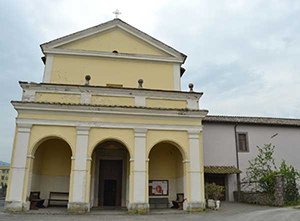
There is little historical information regarding the Franciscan convent of Vitorchiano, however it is known that the religious structure was built in 1793, the year in which work was also started on the Church of Sant’Antonio da Padova, which stands next to it. The convent is made up of three blocks of different heights. At the junction point of the buildings stands the bell tower, quadrilateral in shape, which rises on three levels divided by fluted stringcourses, simple between the first and second levels, and double between the second and third. At the center of each level of the tower, there are single-lancet windows surrounded by rings of peperino bricks. The bells are located in the last level. The building overlooking the convent is one of the side facades of the adjacent church of S. Antonio da Padova, which has long windows at the top, while it has two lower ones with slightly stained glass. The lowest building is the actual convent, whose façade is divided in two by a string course, partly in brick and partly in stucco. On it there are windows, inscribed in round arches, which follow one another along the entire length of the facade. At the bottom right is another small window. The convent inside has a very large square cloister, crossed in the center by two stone paths perpendicular to each other, which create squares with grass. A simple circular well is located on the right on a large stone square, and not, as one would expect, at the intersection of the two paths. The well is in peperino stone and has a circular basin. It rests on a circular base that is also wider and very simple, just as simple is the invoice of the well itself. Around the courtyard the walls are marked by round arches with mighty square pillars, which have peperino stones applied along the entire shaft of the pillar. The archway is plastered in white highlighting the width of the arches between which there are stone walls. On the arches there are windows, two of which are surmounted by columbaria, while at the corner, a window converges with a niche created in the wall.
ARCHIVIST HISTORY
The fund of the convent of the Franciscan friars of Vitorchiano corresponds to the
chronological extremes ranging from 1792 to 1946, and was arranged as part of the ordering and inventorying project of the “Closed Convents” section of the archive of the Seraphic Province of San Francesco di Assisi of the Friars Minor in Umbria.
The project, started in 2004, ended the following year, with the preparation of an analytical inventory of the documentary complexes present, by Andrea Maiarelli.
The funds were produced by suppressed convents in which the Reformed Friars Minor and the Observant Friars Minor had settled since the 13th century. Over the centuries, the Franciscan families have belonged to three different provinces definitively reunited, in 1946, in the Seraphic Province of San Francesco di Assisi of the Friars Minor in Umbria.
The concentration in the provincial archive of documents from the convents dates back to at least 1614, when a specific section was set up at the depot of Santa Maria degli Angeli in Assisi. Since then, and especially since the second post-war period, the provincial archivists have regularly inspected the suppressed convents to transfer their documentation to the archive of the Seraphic Province, in order to ensure better protection, as well as to facilitate consultation for studies on Franciscanism. “
DESCRIPTION OF THE FUND OF THE CONVENT OF THE FRANCISCAN FRIARS OF VITORCHINO
The fund contains the minutes of the discretory (reg. 1; 1923-1946); the minutes of sacred canonical visits (reg. 1; 1940-1945); the correspondence (bb. 3; 1792-1935); inventories of furnishings (b. 1; 1916-1945); notes and receipts (b. 1; 1944); the acts of the consortium tax office (b. 1; 1916); income and expenses (reg. 2; 1912-1946); the holy masses (reg. 6; 1926-1946); chronicles and memoirs (reg. 1, b.1; 1912-1946). It should be noted the presence of acts from 1792, prior to the establishment of the Convent and relating to its foundation. Sorting: Identification of 6 series: Minutes of the discretorium, Minutes of sacred canonical visits, Correspondence, Heritage and administration, Holy masses, Chronicles and memories. Information on numbering: Progressive numbering 1-18. “
The documentation was produced by:
Convento di Sant’Antonio da Padova di Vitorchiano Convent of Sant’Antonio da Padova in Vitorchiano
Complesso archivistico Archival complex
The documentation is kept by:
Ordine dei frati minori. Provincia Serafica di San Francesco di Assisi in Umbria Order of Friars Minor. Seraphic Province of St. Francis of Assisi in Umbria
Soggeto conservatore Registrar
ESSENTIAL BIBLIOGRAPHY
L’Archivio storico della Provincia Serafica di San Francesco d’Assisi dei Frati Minori in Umbria. Inventario della Sezione Conventi chiusi (1230-2004), edited by A. MAIARELLI, Santa Maria degli Angeli di Assisi, Edizioni Porziuncola, 2005, (Convivium Assisiense, Archiva, 2, Series of the Theological Institute and the Higher Institute of Religious Sciences of Assisi), 124 – 126
Vitorchiano, il passato presente, edition edited by Fiorenzo Mascagna, historical research by Elide Vagnozzi, Stampa Arti Grafiche Artigiane 2005.
