


Card author:
Location:
Date:

The first certain news regarding the convent of Sant’Agnese is deduced from a donation act by the Chapter of San Giovanni in favor of the Rector of S Arcangelo, dated 1366 and reported in the Vitorchianesi chronicles of the 16th century chronicler. Curzio Gobbino, where the monastery is mentioned under the power of said rector.
Info: Info point Vitorchiano – Pro loco Vitorchiano. Piazza Roma, s.n.c. Tel. 0761373739 prolocovitorchiano@gmail.com – infopointvitorchiano@gmail.com

Comune di Vitorchiano, Uff. Turismo – Piazza Sant’Agnese, 16 – cap. 01030 – tel. 0761373745. Comune di Vitorchiano, e-mail info@comune.vitorchiano.vt.it
Municipality of Vitorchiano, Tourist Office – Piazza Sant’Agnese, 16 – chap. 01030 – tel. 0761373745. Municipality of Vitorchiano
e-mail info@comune.vitorchiano.vt.it




FORMER MONASTERY OF SANT'AGNESE today MUNICIPAL AUDITORIUM
HISTORY
The convent of Sant’Agnese was probably founded after 1217, following the privilege granted by Pope Honorius III to the Chapter of St. John Lateran, which provided for the construction of churches and religious institutes in the various dioceses without direct bishop’s authorization. The first certain news, however, is deduced from an act of donation by the Chapter of San Giovanni in favor of the Rector of S. Arcangelo, dated 1366 and reported in the Vitorchianesi chronicles of the 16th century chronicler. Curzio Gobbino, where the monastery is mentioned under the power of said rector. From the scarce information learned through the aforementioned chronicles, nothing can be deduced about the position and size of the convent, it is however possible to hypothesize that initially the religious complex was composed of a few buildings on the eastern side of the tufaceous spur of Vitorchiano close to the ancient wall walls, the remains of which are still visible today. From the analysis of the architectural structure and the wall typology, it can be established that the construction of this section took place between 1250 and 1450. Very useful for finding information is an inventory of municipal real estate of 1520-1522, which contains the following description of the Town Hall: “palace with garden and tower from heaven to earth located inside the castle at the monastery of Sant’Agnese”. At the end of the alley of Sant’Agnese stood the primitive church of the convent, today a small room adjacent to the courtyard, characterized by an apse. In 1578 it was entrusted to Giovan Battista Troiano, architect of card. Altemps, the commission to create a new project for the liturgical place. From the documentation kept in the diocesan archive of Bagnoregio we learn that the work on the new structure took a long time, due to disputes with the citizens, contrary to the use of the municipal garden as a site for construction. The construction of the church was therefore possible thanks to the collapse of a section of the adjacent castle walls, from which sufficient material was obtained for the construction. In 1631 new works were carried out to expand the structure. The last transformations of the monastic complex were carried out between the seventeenth and eighteenth centuries, when the third floor was raised, the bell tower was built in the novitiate arm and the Sant’Agnese tower was annexed. From the end of the eighteenth century there was a progressive decline of the religious complex, so much so that in the postwar period first the schools and then the housing for displaced people moved there, until the site was completely abandoned around the 60s of the twentieth century. In recent times the premises of the former monastery have housed a hotel, and since 2011 has been the current destination for municipal use as an auditorium of the former Baroque Church adjacent to the Convent of S. Agnese, within which the administration organizes in addition to shows and concerts, also exhibitions and conferences.
DESCRIPTION
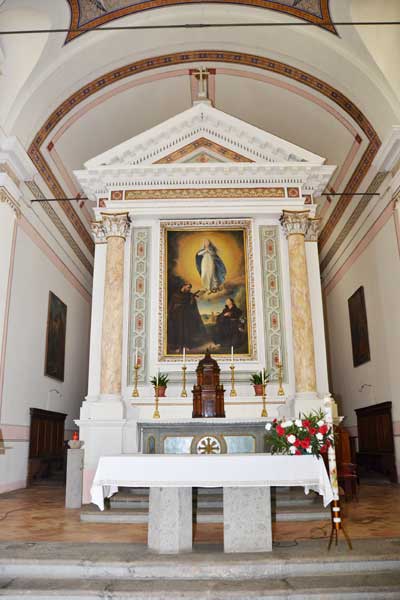
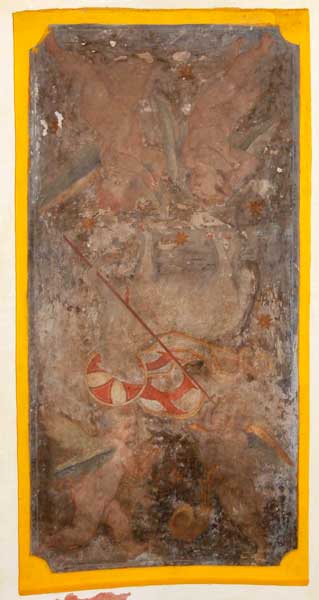
Access to the structure of the former monastery of Sant’Agnese in Piazza Sant’Agnese is characterized by an entrance arch, with a ring ending in an ogive, which introduces the driveway leading to the entrance of the former monastic complex, and to the former church, now the municipal auditorium. Next to it, on the left, raised, is the entrance door to the Monastery with fluted jambs and architrave decorated in the center with the Agello in high relief (symbol of Saint Agnes), and engraved with the phrase MONAST / S AGNETIS. The following inscription is then engraved on the wooden portal: ORDINI SS AUGUSTINI / A D MDCXXXVIII. After walking up the driveway, past the access arch, you arrive in front of the actual structure. The facade with the entrance to the building is divided into two levels by string courses. The access level to the building is characterized by a high round arch; aligned with the door, the first level has a rectangular niche with fragments of fresco with the image of Saint Agnes. The representation almost completely erased, is a work of the sixteenth century, made by artists from Viterbo. Above the niche, always aligned, a round stuccoed inside. The last level is characterized by a small window, also aligned with the entrance door. As soon as you pass the entrance atrium with a cross vault, you can see the cloister of the former monastery. On the right of the atrium is a large portal, access to the church of the monastic complex. The portal has the lintel engraved with an inscription, in the center of which there is a papal coat of arms with the tiara and decussed keys. The entrance portal, as stated in the inscription on the architrave, was built at the end of the 15th century, by Giorgio M., SACRO SANCTE LATERANENS ECCLE // M. GIORGIO ME FECIT IN MILE: 4 9 X. The adjacent former Baroque church at the Convent of S. Agnese it is a beautiful room which, in addition to hosting conferences, concerts, exhibitions, etc., allows you to celebrate the rite of civil marriage through the Municipality of Vitorchino. The interior of the Auditorium, with a single nave with a barrel vault, having absorbed its function as a church, has three stucco altar pediments on the back and side walls, made between the 16th and 17th centuries. The central altar, with golden lines, consists of two columns in faux green marble and two mutually coupled pillars that support a jutting broken tympanum, detached from the horizontal wall and which therefore extends towards the central nave. In the center, above, a stucco canopy is erected, flanked by golden cherubs that indicate the descent of the Holy Spirit, made in the center of the canopy. At the bottom, within a cartouche, there is an inscription in Latin: HIC EST FILIUS MEUS. At the center of the altar was the canvas with the Baptism of Christ, now in the Council Chamber within the Municipality. On the right wall, there is the sixteenth-century altar pediment, in stucco. On a high quadrangular base, two columns with Corinthian capitals support the projection of the broken tympanum. Between the two parts of the tympanum, leaning against the wall, an arch rises, in which space is the Lord, surrounded by cherubs, on whose head a large shell is placed. Christ holds the globe in his hand while on the sides are two Blessed. Putti in stucco are placed on the sides of the coat of arms on the summit of the arch, interposed in a band with a rising straight and an inverted horseshoe. On the side, the altar has two other rectangular mirrors decorated with ovules, surmounted by cherubs in stucco and ribbons. This altar kept in the center the canvas with the Madonna and Child with Saints Dominic and Catherine and the mysteries of the Rosary, while on the sides were the paintings depicting Saint Lucia and Sant’Orsola. The other seventeenth-century stucco altar pediment is located on the left wall. It is presented on two bases decorated in bas-relief, on which rest columns with foliated capitals, which support a broken tympanum. This is crossed by oval frames and decorated with cherub heads. Other stucco cherubs are seated on the oblique sides of the tympanum, others on the lunette that crowns the top, still others crouched in the deep niche below, decorated in turn with plumes and bows. In a cartouche, in the center of the architrave, there is a Latin inscription: DIV. P. AVGVST. D. This altar kept in the center the canvas with St. Bonaventure between St. Augustine Bishop and St. Agnes, while on the sides were the paintings depicting St. Apollonia and St. Catherine. On the left side wall there are also two windows closed by grates, of which the upper one, with a stucco frame with a winged cherub face in the center. At the end of the wall, carved into the wall, is a false raised door, with a small window in the center. The lateral mirroring of the third stucco altar pediment, dating back to the 17th century, is visible. At the beginning of the left side wall of the classroom, there is a false raised door, with a small window in the center, carved into the wall. The left wall of the church is closed by a window with a grate, beyond which another room is visible. Another wonder to be rediscovered, restored and enhanced is the ancient organ placed in the choir loft above the entrance, inside the Auditorium. On the counter-façade at the top is the 19th century choir loft. of Viterbo area. The balustrade divided into three large panels is decorated with regular designs of leaf whirls imitating brocade with applications of ten-pointed stars in the center. The upper part, laterally decorated in the day, has a squared arch in the center. In the center of the vault, a painting of the XVI-XVII century. of the Viterbo school, within which the image develops in the center with the Agnus Dei and at the ends of the panel two pairs of angels. Leaving the Auditorium and returning to the atrium, you arrive at the cloister of the monastic complex created, on two sides, by the converging of the former monastery with a portico, and a building with a loggia characterized by round arches. On this building there are two entrances, one of which is surmounted by a frescoed lunette. The frescoed lunette on the portal of the building with loggia, from the late seventeenth century, of the Viterbo school, has as its subject the Virgin and Child together with a bishop saint and a girl, very damaged. The bezel is surmounted by a stucco panel decorated in high relief with a shell. Between the two doors is a round arch closed by a glass window and inscribed in an entablature supported by pilasters. Passing under the second arch on the left of the cloister, you reach an access door that leads to the belvedere garden of the monastic complex. The garden of the belvedere overlooks the rear side of the former monastic complex of Sant’Agnese. Below the terrace, there is a view of Vitorchiano and the valley of the Vezza stream. The rear of the complex consists of the presence of two buildings perpendicular to each other, of which what was once the monastery, rises on four floors separated two by two by string courses. The bell tower of the former church stands out between the two buildings.
ESSENTIAL BIBLIOGRAPHY
Vitorchiano, il passato presente, edition edited by Fiorenzo Mascagna, historical research by Elide Vagnozzi, Stampa Arti Grafiche Artigiane 2005.
PACINI L., PACCOSI C., Il Convento di S. Agnese a Vitorchiano, in “Biblioteca e Società. Review of the Consortium for the management of the Viterbo Libraries ”, Year XIII, 1994; n. 2, pp. 13-16.
PACINI L., PACCOSI C., Vitorchiano: Storia, Degrado “Recupero”. Il Convento di S. Agnese, in “A. V. Architetti Viterbo. Periodical of the Order of Architects of Viterbo and Province “, Year VIII, 1992 n. 3, pp. 34-37.
Picchetto F.- Pedrocchi A. M , scheda OA n. 12/ 00095477, 1977.
Picchetto F.- Pedrocchi A. M , scheda OA n. 12/ 00095479, 1977.
Picchetto F.- Pedrocchi A. M , scheda OA n. 12/ 00095481, 1977.
Picchetto F.- Pedrocchi A. M , scheda OA n. 12/ 00095487, 1977.
Picchetto F.- Pedrocchi A. M , scheda OA n. 12/ 00095489, 1977;
Picchetto F.- Pedrocchi A. M , scheda OA n. 12/ 00095493, 1977;
Picchetto F.- Pedrocchi A. M , scheda OA n. 12/ 00095494, 1977;
Picchetto F.- Pedrocchi A. M , scheda OA n. 12/ 00095507, 1977;
Special thanks to Dr. Andrea Presutti for scientific advice and archival photographic material provided on Vitorchiano.
– Vitorchiano com’era Facebook page for collecting old photos of the beautiful village of Vitorchiano, in the province of Viterbo. Images of the country, its inhabitants and its traditions.